
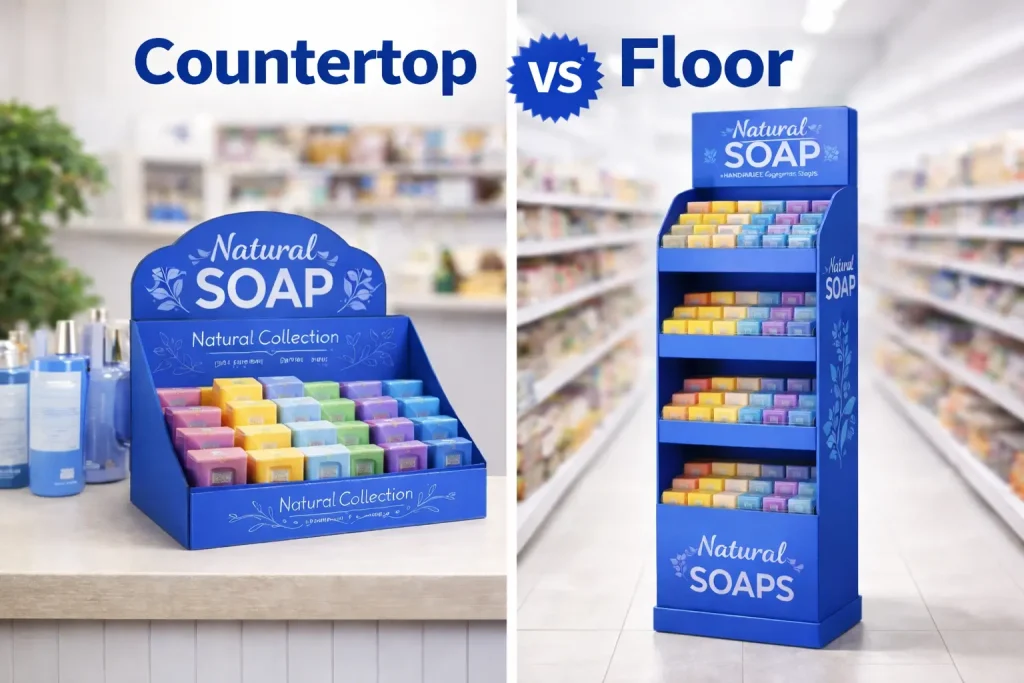
Choosing between countertop and floor displays is not just a packaging decision. It is a merchandising strategy that affects how shoppers notice your soap, how quickly stores can keep shelves full, and how premium your brand looks at the point of sale. The right format helps retailers complete the stock (keep every SKU visible and replenished), while also improving conversion through better placement, clearer product organization, and stronger visual impact. If you are sourcing through a partner like soap boxes wholesale, the goal is to match the display structure to your store environment, SKU count, and the way people actually shop in that aisle.
At a high level, soap display boxes fall into two major categories: countertop units built for impulse zones, and floor units built for scale, assortment, and aisle-level dominance. The best choice depends on capacity needs, store layout, replenishment cadence, and the brand “beauty” you want shoppers to feel.
What countertop displays are (and when they win)
Countertop displays are small-footprint units designed for high-traffic touchpoints: checkout counters, reception desks, pharmacy counters, salon front desks, and endcap ledges. They win when you need a quick setup, a low-cost trial placement, or a punchy visual that sells a few hero scents fast. They also simplify staff restocking because the product is contained in one easy-to-lift unit rather than spread across shelves.
Use countertop soap display boxes when your priority is speed, impulse visibility, and limited counter space, especially for giftable soaps, travel sizes, and seasonal “try me” assortments.
What floor displays are (and when they win)
Floor displays are freestanding units placed in aisles, near entrances, endcaps, or promotional zones. They hold more units, present more SKUs at once, and create a stronger brand billboard effect. They are best when you want to scale distribution in a larger retail footprint, run a promotion, or support multiple product lines (bars, gift packs, bundles, refills).
Floor displays also reduce the risk of “out of sight, out of stock” because they make inventory visible to staff and shoppers. When a store sees the display thinning, replenishment becomes obvious and urgent.
Inventory and stock completion (keeping every SKU available)
A display should help retailers maintain availability across sizes and scents. Countertop units are excellent for tight, curated sets (for example, 3 to 6 best sellers). Floor displays support broader coverage, including premium tiers and bundles, because they have the depth to carry more backstock.
For quick placements or test launches, small soap display boxes can be ideal because they reduce risk for the retailer and make it easier to rotate scents without wasted space.
Sales impact (placement, psychology, and conversion)
Sales lift usually comes from three drivers: visibility, accessibility, and clarity. Countertop placement captures impulse behavior, especially when shoppers are already in a buying mindset at checkout. Floor displays can drive planned purchases by acting like a dedicated “soap destination” that shoppers discover while browsing.
A key tactic is matching capacity to demand. If a display sells well but empties too quickly, the visual turns from “popular” into “picked over,” which can reduce trust and perceived quality. That is why many retailers prefer large soap display boxes for high-volume locations, because the presentation stays full longer and the brand looks consistently available.
Beauty and brand perception (why the display has to look premium)
Soap is a sensory product, so beauty matters. Color consistency, clean edges, and print quality influence whether shoppers interpret the soap as artisanal, clinical, luxury, or mass-market. Display design should support your brand story through typography, photography, and finishes that complement the scent and ingredients.
High-quality printed soap display boxes can elevate perceived value when paired with clear merchandising cues like scent families, “best seller” callouts, and organized rows that feel boutique rather than cluttered.
Types and configurations (countertop and floor)
Countertop configurations typically include tiered trays, divider-style CDUs, shelf-ready trays, and compact counter bins. Floor configurations commonly include freestanding display units (FSDUs) with shelves, dump bins for high-volume promotions (less premium, more impulse), and sidekick-style add-ons when allowed by the retailer.
When you need a recyclable, lightweight solution with strong print flexibility, cardboard soap display boxes are widely used because they balance cost, visual quality, and quick replacement during seasonal rotations.
Manufacturing guide (materials, printing, finishing, and strength)
Manufacturing quality controls durability, safety, and how “expensive” the display looks. The right material depends on load, shipping distance, and how long the unit must survive on the retail floor.
Paperboard (SBS) often works best for premium countertop units because it prints cleanly and holds crisp edges. Kraft board supports an eco-forward look and hides scuffs well. Corrugated is usually the best choice for floor units and heavier loads, especially when using E-flute or B-flute structures. For additional protection, consider aqueous coating for scuff resistance, or lamination for higher shine and longer campaign life. Finishes such as matte, spot UV, embossing, or debossing can increase shelf impact when used with restraint.
For higher-strength builds, corrugated soap display boxes structures should include reinforced shelves, locking tabs, and weight testing so the unit stays straight and premium in high-traffic aisles.
CENTER: Countertop vs Floor comparison graph
| Factor | Countertop Displays | Floor Displays |
| Footprint | Very small, counter-friendly | Larger, requires aisle or endcap space |
| Capacity | Low to medium | Medium to very high |
| Best locations | Checkout, front desk, service counters | Endcaps, aisles, entrances, promo zones |
| SKU breadth | Focused assortment | Broad assortment plus bundles |
| Setup time | Very fast | Moderate, sometimes multi-piece |
| Replenishment | Simple, but more frequent | Less frequent, often with built-in backstock |
| Branding area | Compact, high impact up close | High visibility from a distance |
| Sustainability | Great with paperboard, easy to recycle | Great with corrugated, can replace plastic fixtures |
| Durability needs | Moderate | Higher (traffic, bumps, longer campaigns) |
| Typical cost | Lower entry cost | Higher, but better for scale and long runs |
Sizing guide and use cases (how to match the unit to your SKUs)
Sizing should be determined by bar dimensions, pack count per SKU, and retailer constraints such as counter depth, aisle width, and planogram rules. As practical ranges, countertop displays often support about 12 to 48 units depending on tiers and depth, while floor displays can support 60 to 300+ units depending on shelves and footprint.
In US retail programs, compliance can matter as much as design. If your goal is broad distribution with consistent execution, plan for retailer-friendly dielines and easy assembly. That is where display boxes for products usa retail requirements become important, including durability expectations, footprint limits, and store staff setup time.
How to choose (decision checklist)
Use this simple checklist to decide what to build, and how to spec it for performance and brand presentation:
- Define the mission: impulse trial (countertop) or full assortment visibility (floor).
- Map the store type: boutique, grocery, pharmacy, salon, convenience.
- Count SKUs and velocity: few hero scents vs broad catalog, slow vs fast movers.
- Choose capacity and replenishment reality: how often staff can refill without friction.
- Select materials and finishes: durability, recyclability, and the “beauty” level you want.
- Prototype and test: shelf sag, scuffing, assembly time, color accuracy, and weight limits.
If you are building for search visibility and buyer intent, include semantic phrases naturally (not stuffed) such as custom printed soap packaging, retail-ready packaging, POS display packaging, shelf impact, merchandising, brand visibility, impulse purchase, and eco-friendly packaging. Include location-intent LSI like custom soap boxes in USA when it fits the context and the buyer journey.
Common mistakes to avoid
A common mistake is building a display that looks great but runs out too fast, or carries too many SKUs in a small unit, causing messy mixing and slow shopping. Another frequent issue is weak shelf support on floor units, which leads to sagging and a cheap look. Also avoid overloading the design with text; shoppers need quick scent navigation and clear value cues more than long copy at the point of sale.
FAQs
Which display sells more, countertop or floor?
What is the best material for a premium look?
Are corrugated displays only for floor units?
How many SKUs should I put in one display?
How do I keep the display looking full?
Conclusion
Countertop displays excel when you want fast placement, impulse sales, and a tight curated assortment. Floor displays excel when you need scale, stronger brand presence, and better stock completion across many SKUs. If you plan around real replenishment behavior, material strength, and clean visual merchandising, you improve both sell-through and perceived beauty on shelf. When you are ready to scale production and maintain consistent quality, soap boxes wholesale sourcing should be guided by prototypes, retailer constraints, and a clear plan for how the display supports inventory and sales goals.


