
Quick Answer (Summary Box)
Soap display boxes influence purchasing decisions before a customer ever touches a product. In retail, they serve as silent salespeople — communicating brand value, ingredient transparency, and shelf appeal simultaneously. Done right, they increase units-per-transaction and reduce return rates. Done wrong, they cost you shelf space and customer trust.
The $40,000 Lesson I Learned in Aisle 7
Twelve years in packaging teaches you things textbooks don’t cover.
Early in my career, I worked with a mid-sized artisan soap brand out of Austin, Texas. They had a genuinely great product — cold-pressed, locally sourced, with beautiful scent profiles. We printed their boxes on a 16pt paperboard with a soft-touch matte finish. They looked stunning in our proofing room.
They bombed on the shelf.
Three months in, the brand owner called me frustrated. Units weren’t moving in their regional Whole Foods location. We visited the store together, and the problem became obvious — under fluorescent retail lighting, their earthy brown kraft design disappeared against neighboring products. The soft-touch coating, which looked luxurious up close, read as dull from a distance.
We redesigned with a strategic spot UV coating on the logo and switched to a cleaner white base. Sales increased by 34% in the following quarter.
That experience reshaped how I think about soap display boxes. They aren’t packaging. They’re retail performance tools.
The Real Cost of Ignoring Your Soap Packaging
Most soap brands underinvest in display boxes because they view them as a cost, not a conversion asset.
This is one of the most common mistakes — and it’s expensive.
A 2024 study by POPAI found that 76% of purchase decisions in retail are made at the point of sale. Your box is doing the selling, not your marketing budget.
When a customer stands in front of a soap aisle with multiple options, they spend only a few seconds scanning before choosing. Your packaging must justify the price instantly.
What Soap Display Boxes Actually Do in Retail
1. They Establish Perceived Value Instantly
Premium materials signal premium products.
A soap priced higher but packaged in a weak or poorly designed box will be ignored in favor of a competitor with stronger presentation. Shoppers judge value through packaging before price.
Embossing, foil stamping, and rigid structures are not extras — they justify pricing.
2. They Communicate Ingredients Without a Conversation
Retail staff won’t explain your product. Your box must.
In natural and organic retail environments, customers actively scan for certifications, key ingredients, and origin claims. A well-structured printed soap display box highlights a strong front-facing claim with supporting details on the sides or back.
3. They Protect Shelf Integrity Over Time
A box must maintain its look even after weeks on the shelf.
Soaps are handled frequently by customers. Poor-quality packaging quickly shows wear — dents, smudges, and damage. This creates a negative impression and reduces purchase likelihood.
A damaged box signals poor quality, even if the product is excellent.
The Specific Mistake That Kills Soap Sales on Shelf
The biggest mistake is designing for photography instead of retail lighting.
Product photos are taken under controlled conditions, while retail environments use mixed lighting that alters color and contrast.
Before finalizing any cardboard soap display box design, a physical shelf simulation test is essential:
Print a sample, place it under real store lighting alongside competitors, and observe it from a distance.
If it doesn’t stand out in that environment, it won’t perform in-store.
What Actually Moves Units
From long-term client data across retail placements, these packaging features consistently impact performance:
- Spot UV on logo or key visuals increases perceived premium quality
- Window cutouts increase engagement for handmade or artisan soaps
- Matte finishes perform better for natural brands; gloss works better for luxury
- Ingredient callouts on the front improve conversion in health-conscious markets
- Sturdy corrugated soap display boxes outperform sleeves in high-traffic retail environments
Two Packaging Strategies Most Brands Overlook
Strategy 1 — Design for Return Visit Recognition
First-time buyers discover your product. Repeat buyers need to recognize it instantly.
Strong visual consistency — such as color blocks, layout, or logo placement — ensures quick recognition and drives repeat purchases.
Strategy 2 — Engineer for Retail Compliance
Retailers have strict planogram and packaging requirements.
Ignoring these can result in lost shelf placement, even if the product is excellent.
Before finalizing your box, ensure:
- Dimensions fit shelf requirements
- UPC placement is scannable and visible
- Packaging aligns with retailer guidelines
Choosing the Right Soap Display Box for Your Retail Channel
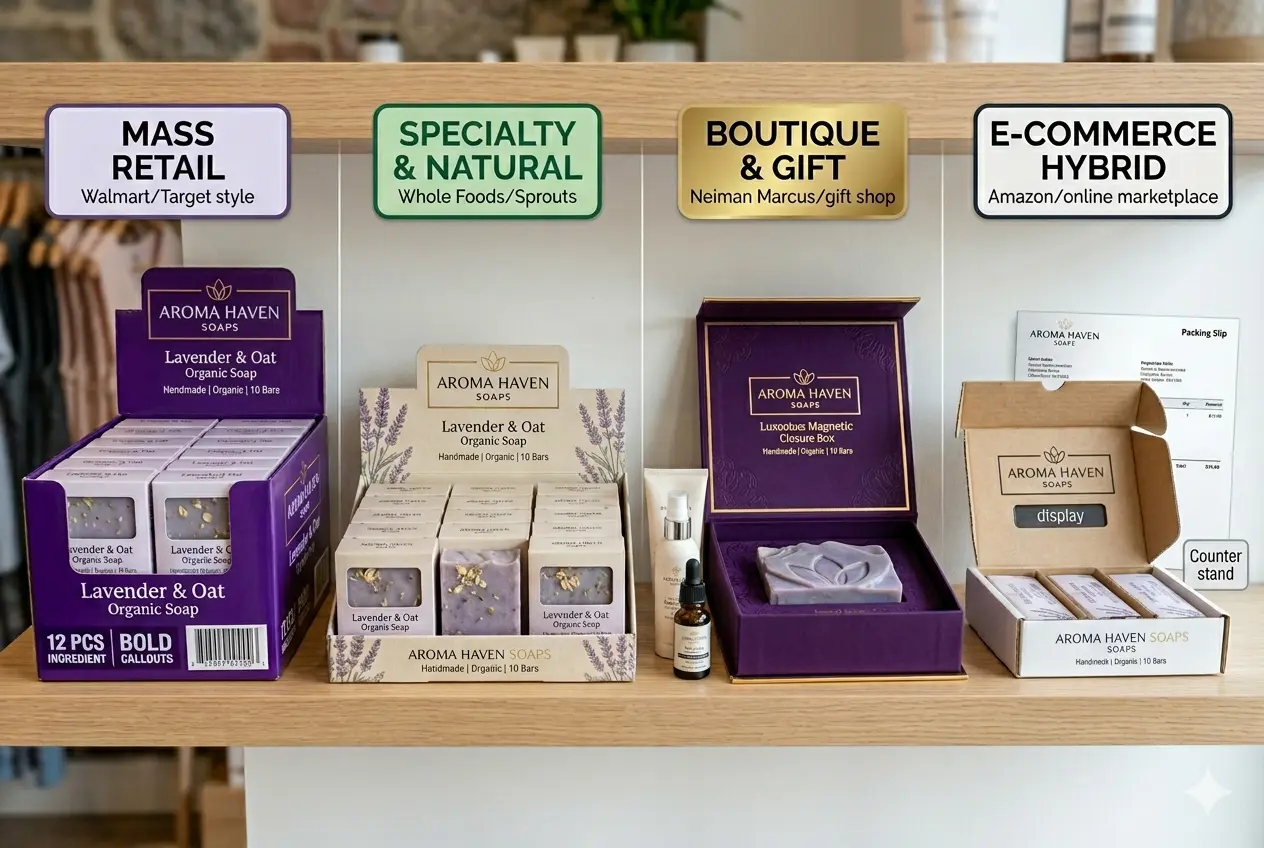
Different retail environments require different strategies:
Mass Retail (Walmart, Target): Focus on durability, high contrast, and clear product visibility. Large soap display boxes work well for bulk shelf facings in this channel.
Specialty / Natural Retail (Whole Foods, Sprouts): Emphasize ingredient transparency, sustainable materials, and tactile finishes. Small soap display boxes are ideal for artisan and single-bar presentations in this segment.
Boutique / Gift Retail: Use premium structures like rigid boxes, magnetic closures, and elevated finishes. Soap bar display boxes with custom inserts elevate the gifting experience significantly.
E-commerce + Retail Hybrid: Design packaging that performs well both during shipping and on shelf. Countertop soap display boxes also work effectively for pop-up and retail counter placements.
Conclusion: Your Box Is Your Best Salesperson
In a retail environment where shelf space is limited and attention is scarce, soap display boxes are critical.
They are often the first — and sometimes only — interaction a customer has with your brand.
If you are launching or improving your soap line, begin with real-world shelf testing. Evaluate how your packaging performs under actual retail conditions.
Design not just for appearance — but for performance.
FAQs


