
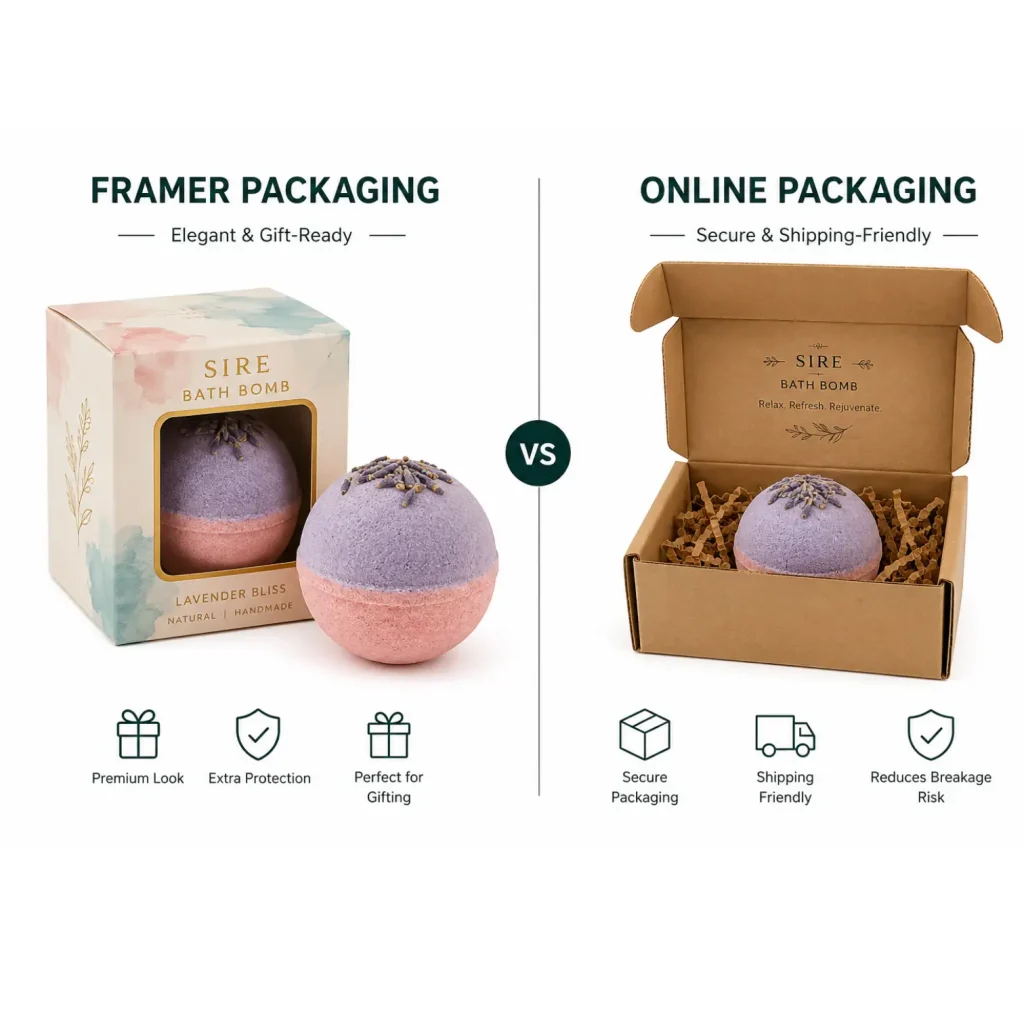
A bath bomb that sells out in an hour at a Saturday farmers market can sit untouched for weeks in an online store, even with the same formula, the same scent, and the same price tag. The difference usually isn’t the product. It’s the packaging. A booth table lets customers pick up a Custom Soap Boxes display, smell it, and decide in seconds. A product page has none of that. It has to do the selling, the protecting, and the shipping all through a photo and a few lines of text. Makers who treat both channels the same way are often the ones wondering why their online numbers never catch up to their market-day sales.
Retail Packaging vs Ecommerce Packaging: Two Different Jobs
Retail packaging vs ecommerce packaging isn’t just a size or cost difference — the two are built to solve completely different problems. One is designed to be judged in person, within seconds, on a table surrounded by other products. The other has to survive a journey it will never be inspected during, and still convince someone to trust what’s inside before they’ve even touched it.
What Retail Packaging Is Built For
Retail packaging exists to be picked up, opened, and sniffed in person, so it leans on open windows, soft textures, and shelf-ready shapes that catch a shopper’s eye from a few feet away. Since a real person is standing right there, the box’s job is finished the moment it earns a second look and a reach of the hand.
What Ecommerce Packaging Is Built For
Ecommerce packaging never gets touched before purchase, so its entire job is to survive a delivery truck, protect a fragile, oil-based product from cracking, and still arrive looking like it’s worth the price paid. A box designed for a farmers market table rarely has the cushioning or seal strength a parcel carrier requires, and that mismatch is where a lot of returns and one-star reviews start.
| Packaging Factor | Farmers Market / Retail | Online / Ecommerce |
| Primary goal | Attract attention, allow touch | Survive transit, build trust remotely |
| Structure | Open window, lightweight | Reinforced, cushioned, tamper-evident |
| Decision time | Seconds, in-person | Minutes, based on photos alone |
| Biggest risk | Getting overlooked on the table | Arriving cracked or crumbled |
Bath Bomb Packaging for Online vs In-Store Selling
Bath bomb packaging for online vs in-store selling comes down to what the box has to physically endure. In a store or at a market stall, a box only travels from a supplier’s shelf to a table and then into a customer’s bag — minimal handling, no stacking, no temperature swings. Online, that same bath bomb might sit in a warehouse, get loaded onto a delivery truck next to heavier items, and get dropped at a doorstep in the rain. Without a rigid, fitted insert, even a well-made bath bomb can arrive as fragments. This is exactly where retail soap boxes succeed on a table but fail the moment they’re handed to a shipping carrier instead of a customer.
Where Online Packaging Falls Short While Retail Packaging Works
A box that performs well on a table can still fail online, and the reasons are rarely about the artwork. Understanding why online packaging fails when retail packaging works usually comes down to structural choices that were never tested against a real shipping journey.
Common Failure Points in Shipped Packaging
- No internal cushioning, so the product shifts and cracks during transit
- Glue or tuck-flap closures that aren’t strong enough for parcel handling
- No moisture barrier, which lets bath bombs absorb humidity and lose their fizz before they’re even opened
The Weaknesses Retail Never Exposes
None of these problems show up at a market stall, because there’s no truck ride between the box and the buyer. Online, they show up as refund requests, unhappy reviews, and customers who never place a second order because their first impression was a broken product.
Packaging Strategy for Multi-Channel Selling
A packaging strategy for multi-channel selling doesn’t mean picking one box and hoping it works everywhere. It means designing two versions from the same brand identity: one built for visibility and touch, one built for durability and unboxing. Keeping the label design, colour palette, and logo placement consistent across both keeps the brand recognisable, while the structural choices — box weight, insert type, and closure style — are adjusted separately for each channel’s actual conditions.
A Quick Checklist Before Ordering Packaging
Sellers who run both a stall and an online store often keep a simple internal checklist before finalizing any packaging order:
- Will this box be opened and handled by a stranger before purchase, or sealed and shipped sight unseen?
- Does it need to survive a two-day parcel journey, or just a folding table for six hours?
- Is the closure strong enough for the actual handling method it will face?
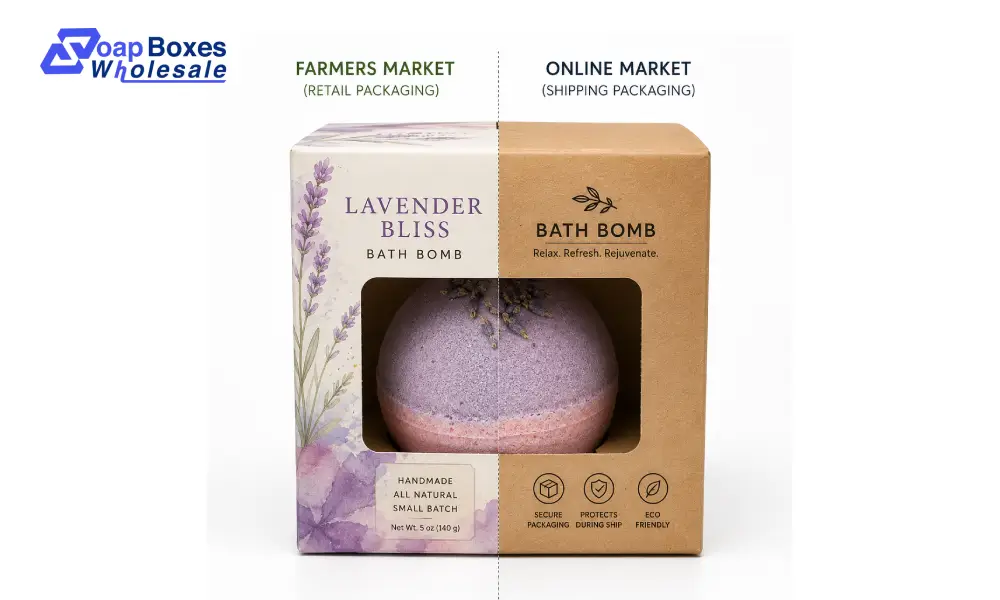
Farmers Market Packaging vs Shipping Packaging
Farmers market packaging vs shipping packaging is really a question of distance. Market packaging only has to survive the short trip from a tent to a tote bag, so it can prioritize a bath bomb packaging window that shows off color and texture. Shipping packaging has to survive freight handling, long-haul transit, and porch drop-offs, so it needs sturdier board weight, a fitted insert, and a closure that won’t pop open mid-transit.
Choosing Packaging Built for the Right Journey
Businesses that scale from local markets into online sales usually learn this gap the hard way, through damaged-item complaints that never happened at the booth. Getting it right doesn’t take guesswork. The right packaging partner designs around how a product actually reaches the customer, whether that’s a handoff at a stall or a multi-day parcel journey. A well-built soap boxes with window option can serve both purposes, as long as the structure underneath matches the rougher of the two trips.
Final Thoughts
Selling the same bath bomb through two channels isn’t a marketing problem. It’s a packaging decision, made once, before the first box ever ships. Matching the box to the journey, not just the shelf, is what keeps a product looking as good on a doorstep as it does on a market table.


